The club
Provides the creative environment, authors, and ideas.
Imagine YouTube or Instagram where, instead of a regular feed, you have the world around you — creators, artists, museums, and theaters have built interactive performances, digital art objects, and picture galleries, restored events from the past, and musicians play around you and local businesses offer their services and products
Imagine YouTube or Instagram where, instead of a regular feed, you have the world around you — creators, artists, museums, and theaters have built interactive performances, digital art objects, and picture galleries, restored events from the past, and musicians play around you and local businesses offer their services and products
Avento displays immersive content around you — AR characters, digital galleries, 360° scenes, 3D models, transparent video, historical reconstructions, portals, and AI voice guides.
The technology is ready — and a public platform for AR content is here
In recent years, the largest technology companies have invested enormous resources into building a digital layer over the real world.
Google has collected billions of Street View images and aerial photographs and uses AI to build three-dimensional representations of cities. Immersive View, for example, lets people explore cities and landmarks in 3D, while Google Maps Platform gives developers Photorealistic 3D Tiles. Google also continues to advance AR navigation and recognition of the surrounding space through Lens/ARCore.
Apple is building its own spatial ecosystem: ARKit, RealityKit, Reality Composer Pro, and visionOS. Modern devices can understand the geometry of the surrounding space, place virtual objects in it, and blend digital content with the physical world.
So the technical foundation already exists: smartphones can run AR, cities are represented by vast amounts of geodata and 3D information, and creating 3D content is becoming more accessible.
But there is still no full analogue of YouTube or Instagram for AR space.
YouTube let anyone upload a video and find an audience. Instagram did the same for photos and short videos. In AR, content still mostly lives inside separate apps, ad campaigns, museum projects, and technology demos.
This is where the Avento model becomes interesting: the real city becomes a publishing surface for digital content.
Avento lets you preview content directly in the browser, while full-featured interactive and more complex GPS-AR and Unity scenes run through the mobile app.
An experimental AR laboratory for creators, cities, and local partners
We recently added the ability to place and show AR/VR content both in the Avento app and, in part, directly on the website: 3D models, digital art objects, 360° content, video, and interactive scenes.
It would be exciting to create together a small experimental AR laboratory for artists, architects, designers, craftspeople, musicians, and other creators.
For example, an artist can place a virtual artwork at a specific point in the city, an architect can show a reconstruction project right next to a real building, a craftsperson can present their piece in 3D, and a local historian can create a digital reconstruction of a historic site.
At the same time, we want to treat this as more than a creative experiment. Based on such projects, participants can build real portfolios, offer AR/VR projects to local businesses, museums, festivals, and other organizations, and jointly develop proposals for grant competitions.
Provides the creative environment, authors, and ideas.
Provides the technology infrastructure for publishing and showing AR in the city.
Real public projects for residents, potential clients, and grant funders.
A practical series for creators who want to publish work in the digital layer of the city
Talk, live demos, and a discussion of participants’ ideas. AR as a new tool for artists, architects, designers, craftspeople, musicians, photographers, and local historians.
Open master class No. 1Master class No. 2 · 90–120 minutesA practical workshop: idea → source → digital object → publish → QR → preview → AR. No programming required.
Open master class No. 2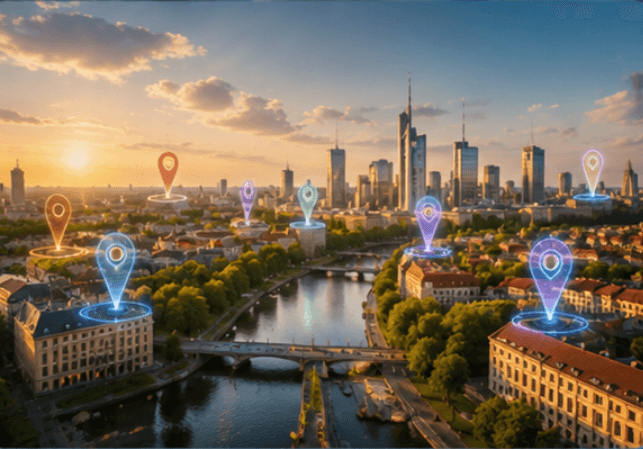
Helps users find interesting places nearby and unlock AR moments in seconds.
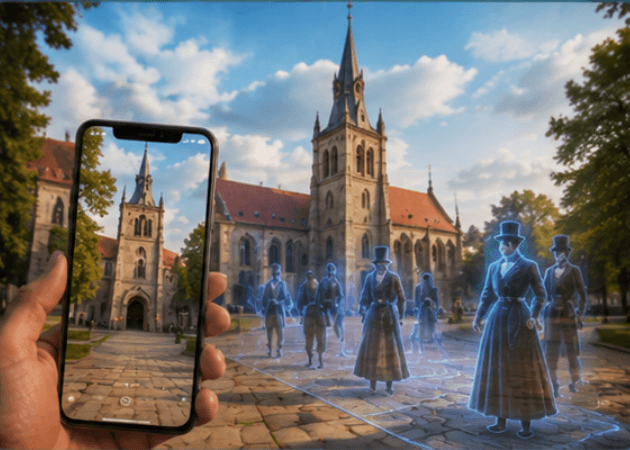
Turns any place into an immersive scene with stories, art, video, and 3D in AR.
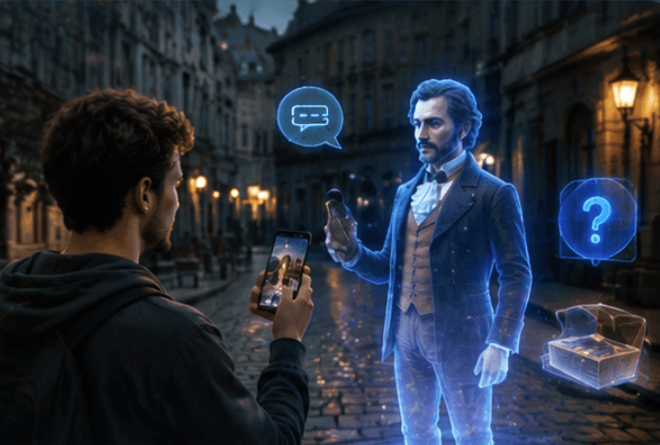
Lets users talk with characters, complete quests, and explore interactive objects around them.
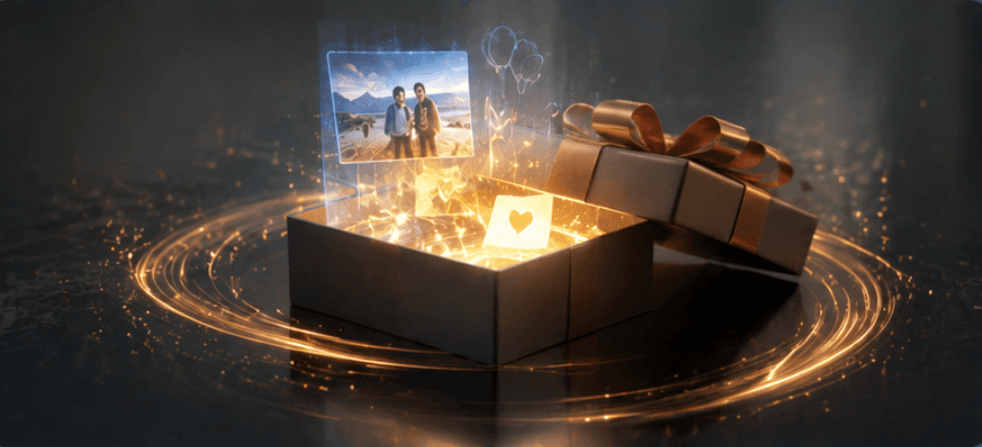
Carefully keeps personalized AR gifts and memorable moments that people want to receive and return to.
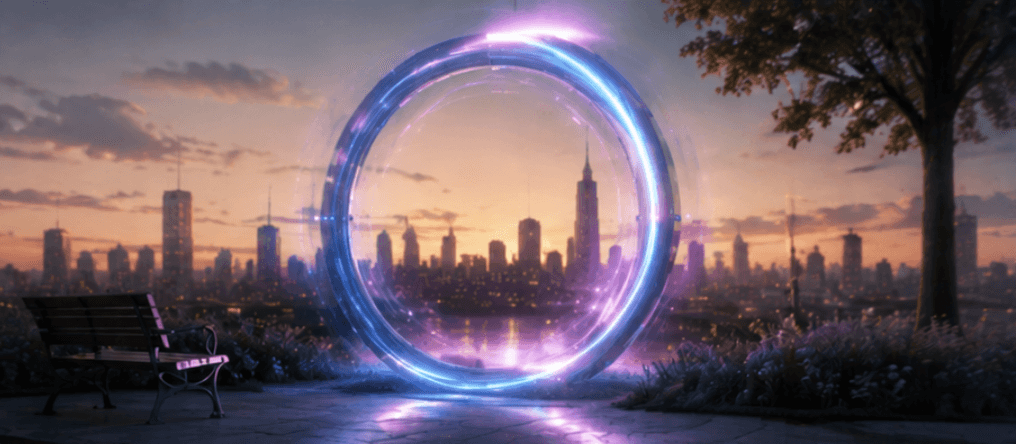
Turn any place into a stage. Step through an AR portal to experience immersive shows, performances, digital art, historical scenes, and virtual events.
The same VR Experience modes available when editing an offer — surface AR, GPS pins, 360 media, video planes, and native Unity scenes.
Surface AR — place historical objects, architecture, products, and characters on a table or floor. A map pin is optional.
Outdoor positioning at a real-world map pin — characters, portals, and interactive objects tied to the place.
Immersive 360° frames that transport visitors to another place, time, or environment.
Cinematic 360° scenes and visual stories tied to a location.
Video in AR at a map pin — including transparent / chromakey content that blends with the real world.
Native Unity AR (UaaL) for portals, art galleries, historical reconstructions, games, and AI guides.
Historical objects, architecture, products, and characters in AR.
Historical figures, virtual guides, and AI-powered characters.
Artworks and exhibitions in real-world spaces.
Another place, time, or environment around you.
Cinematic scenes and location-based stories.
See how landmarks looked in the past.
Step through into another world.
Discover and explore digital content around you.
Talk with Avento characters on location.
Interactive routes, challenges, and hidden AR experiences.
Live experiences from the public Avento AR demo offer — open them in the Avento app to launch AR.
Loading...
Open the full public offer page — gallery, chat, and every immersive experience.
Open the AR demoIdeal for: Museums, artists, cities, attractions, hotels, and local businesses.
Avento connects digital content with real places — publish once and experience it in the app.
A practical series for creators who want to publish work in the digital layer of the city
Talk, live demos, and a discussion of participants’ ideas. AR as a new tool for artists, architects, designers, craftspeople, musicians, photographers, and local historians.
Open master class No. 1Master class No. 2 · 90–120 minutesA practical workshop: idea → source → digital object → publish → QR → preview → AR. No programming required.
Open master class No. 2Available on mobile and desktop

Avento: Spatial Experiences is on Google Play and the App Store.
How to install AventoAvento makes immersive experiences shareable and connected to the real world. Publish and discover AR, 3D, 360° media and AI characters tied to physical locations.